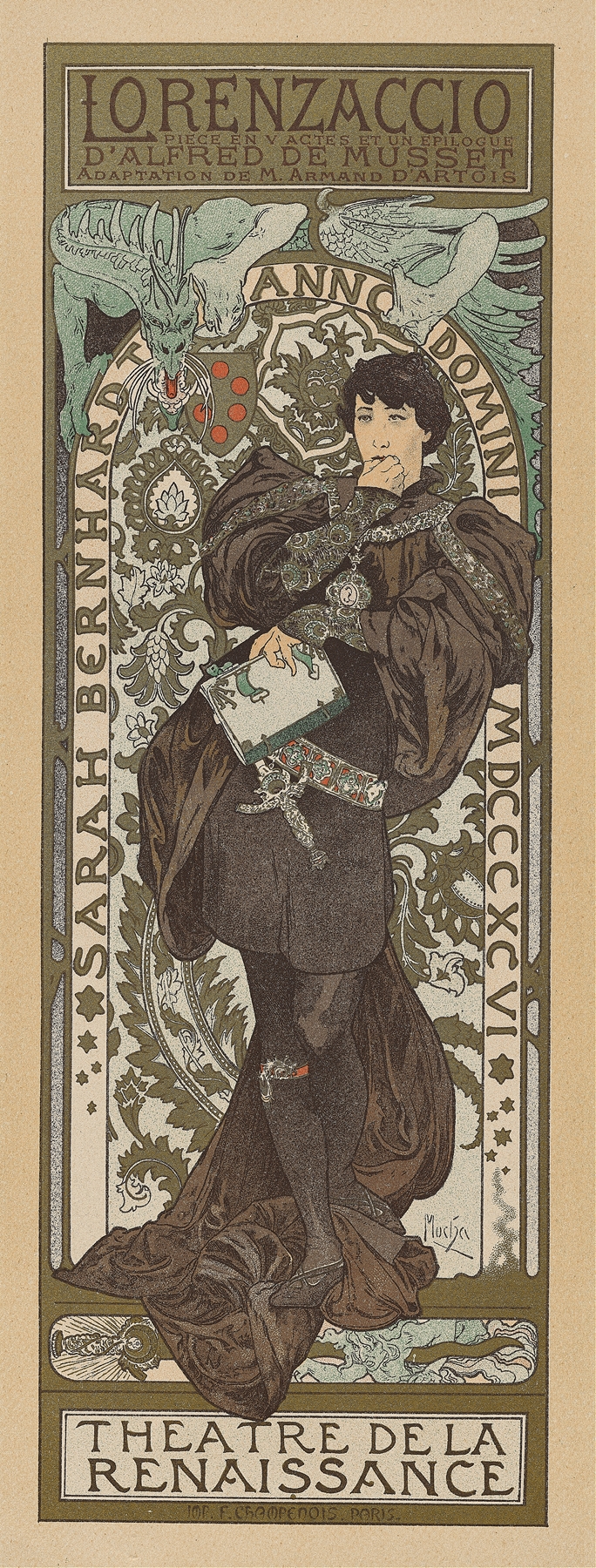
The winged dragon
A green dragon at upper left frames the shield and, with the winged figures, closes the arch. The poster repeats it on the book cover, so it works as a recurring emblem.
The shield with roundels
The shield with red roundels recalls the Medici arms with their palle. The play is about Lorenzo de' Medici, who assassinates the Duke of Florence.
The book with a dragon
She holds a closed book with a small dragon on its cover. With her other hand raised to her mouth, the figure looks thoughtful and withdrawn.
The date MDCCCXCVI
The vertical lettering at right gives the year 1896 in Roman numerals, answered by Anno Domini on the left. The lettering is part of the arch, not an added caption.
The jewelled belt
The belt and chain with small ornaments are the only bright details on the dark costume. Their green and red accents echo the shield and dragon.
Short object reading
Object note
This page stays close to the sheet itself: composition, historical setting, and the work's place in the archive.
This poster announces Lorenzaccio, a play in five acts and an epilogue by Alfred de Musset, in an adaptation by Armand d’Artois, at the Théâtre de la Renaissance in Paris, with Sarah Bernhardt in the title role. The print carries the date MDCCCXCVI (1896) and the imprint of F. Champenois.
Mucha dresses the actress in a dark Renaissance doublet and long cloak, one hand raised to her mouth, the other holding a closed book with a small dragon on its cover. Behind her an arch is filled with a dense damask pattern in olive and cream. Above it, a green dragon and two winged figures frame a shield with red roundels, and the words Anno Domini and the date run down the sides of the arch.
In deep zoom, look at how much the palette is restrained compared with Mucha’s brighter posters: browns, olive and pale green carry the whole image. Follow the damask pattern and the jewelled belt and chain, and read the small capitals of the lettering around the arch.
Go deeper
Related essays
These essays step back from the sheet and open the broader argument around medium, public role, and curatorial context.
Lorenzaccio: a hesitant Bernhardt before a green dragon
Mucha's 1896 poster for Musset's Lorenzaccio dresses Sarah Bernhardt in dark Renaissance cloth and sets her under a damask arch and a green dragon. This essay reads its palette, ornament and detail.
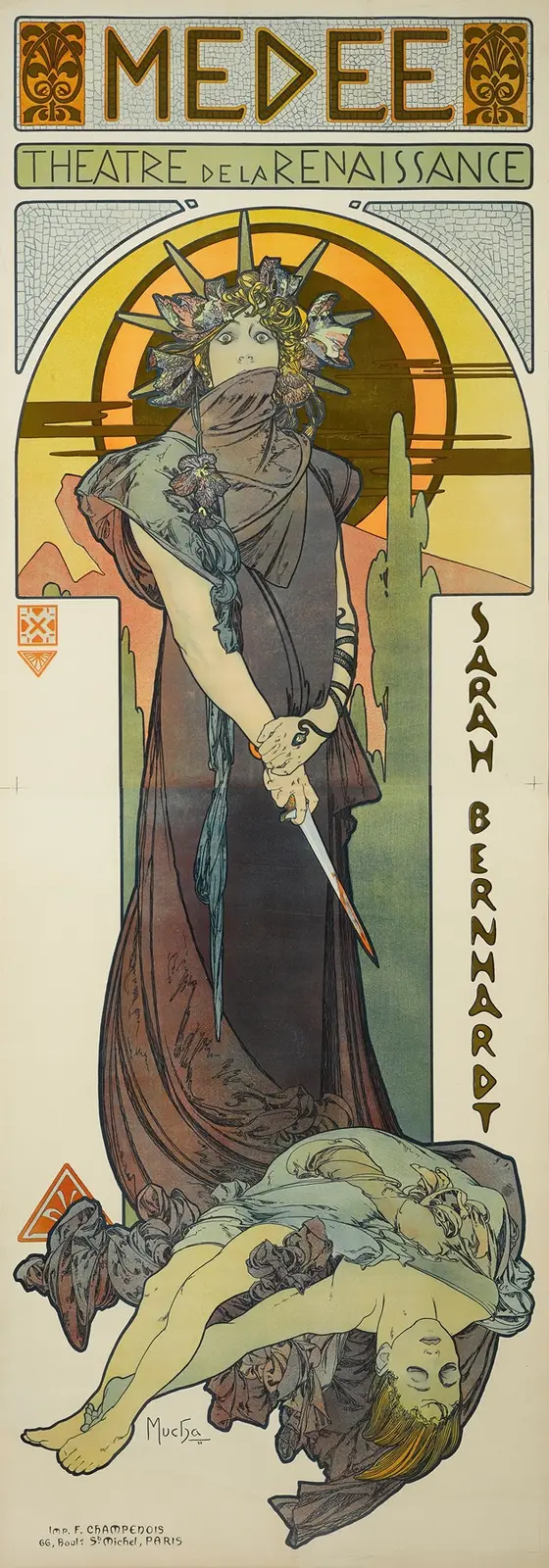
Medee: the sun, the veil and the fallen child
Mucha's 1898 poster for Mendès's Médée shows Sarah Bernhardt veiled before a sun disc, with a bloodied dagger and a fallen child below. This essay reads its bands, lettering and detail.
Related works
 5 explained symbols
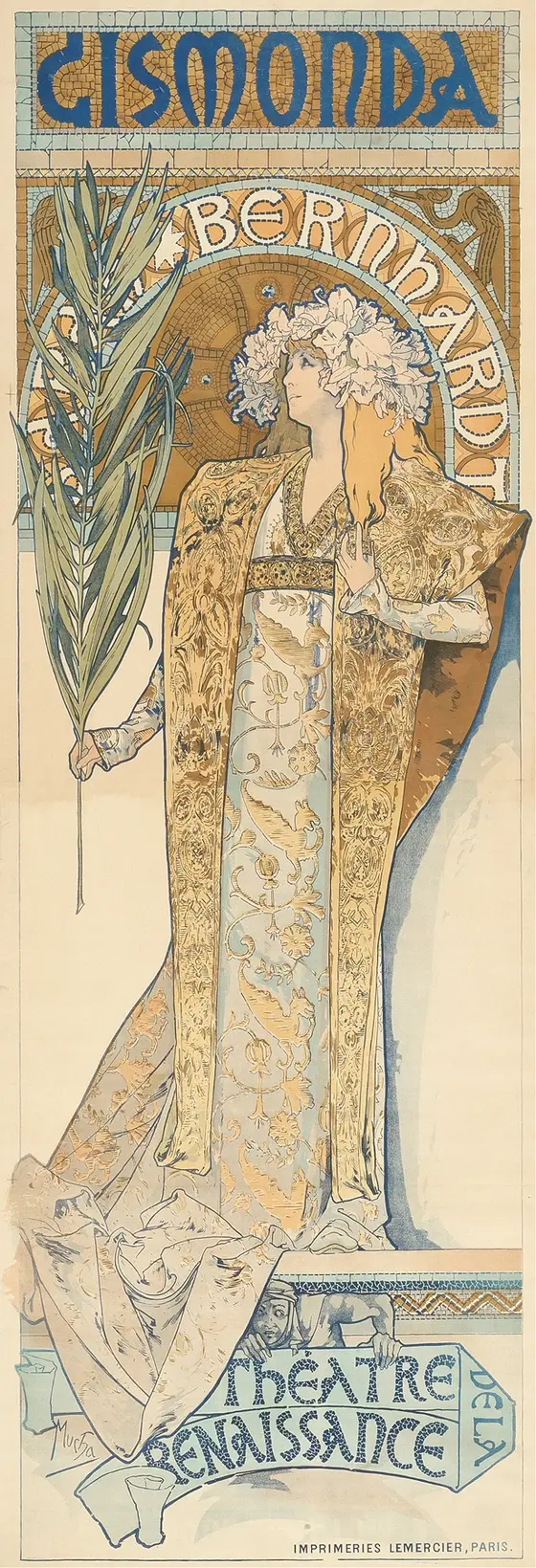
Gismonda
The Bernhardt breakthrough poster that announced Mucha to Paris.
5 explained symbols Medee
A darker Mucha built from ritual tension rather than sweetness.
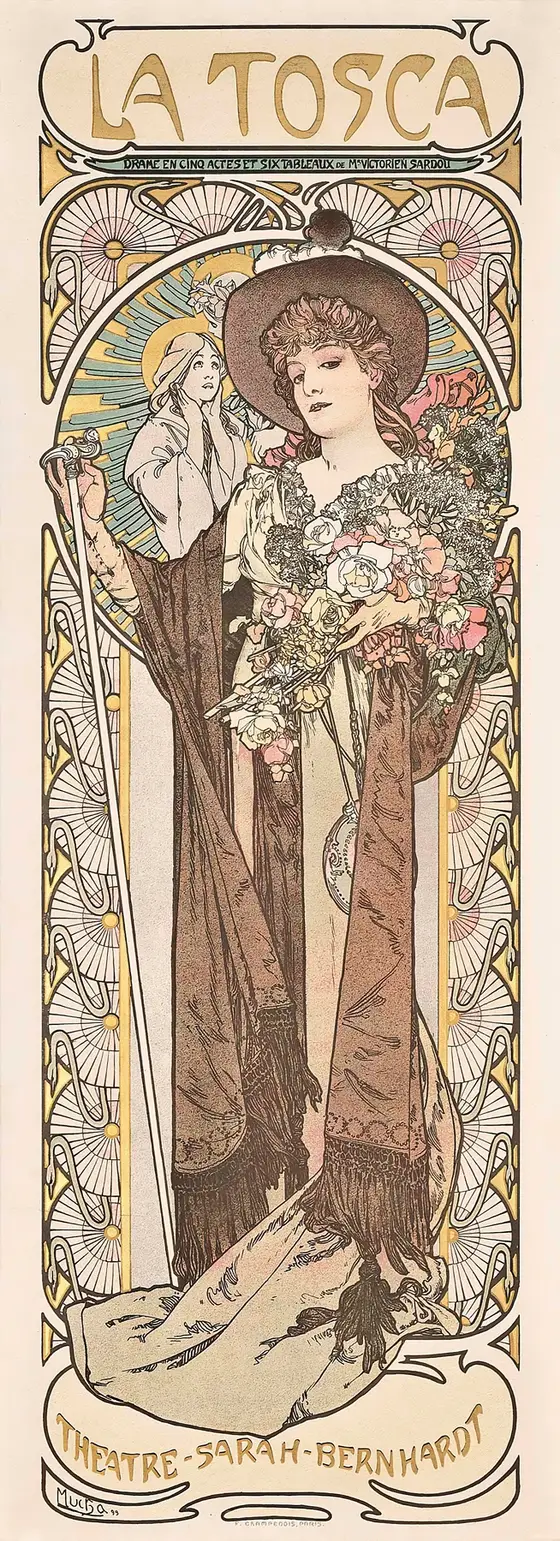
LA TOSCA
Operatic drama compressed into a tall image of ritual tension.
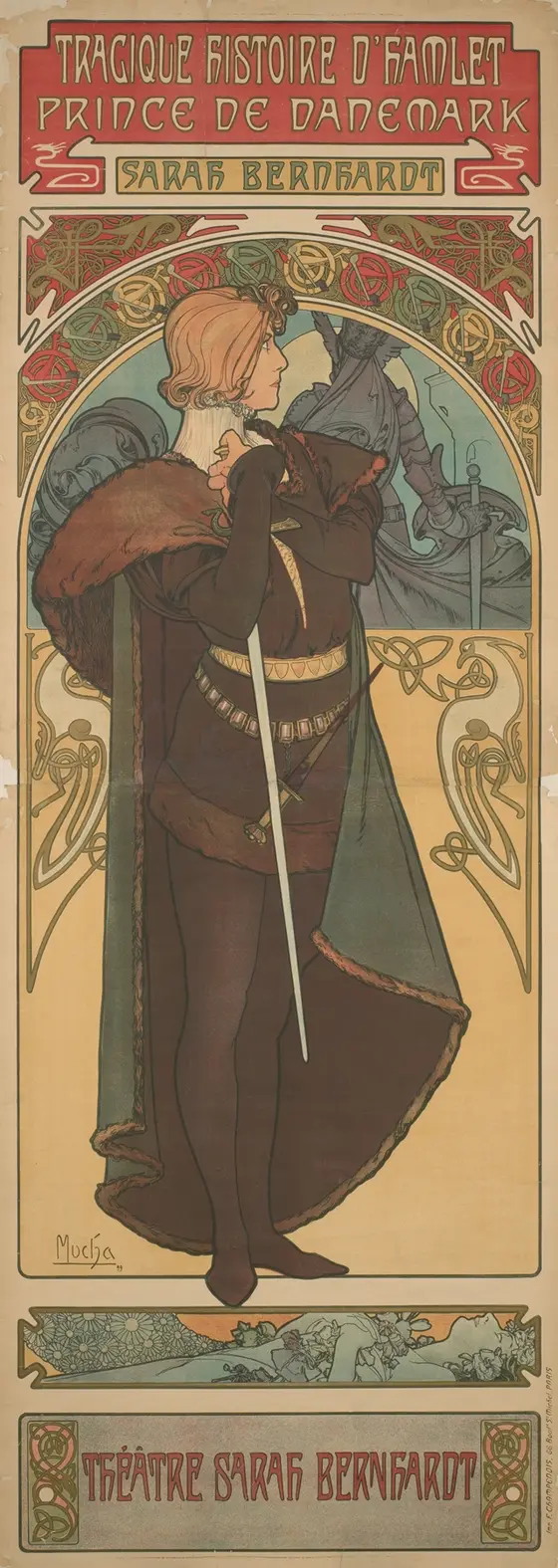
Sarah Bernhardt as Hamlet
Bernhardt as Hamlet, where theatrical identity becomes a monumental emblem of role and presence.