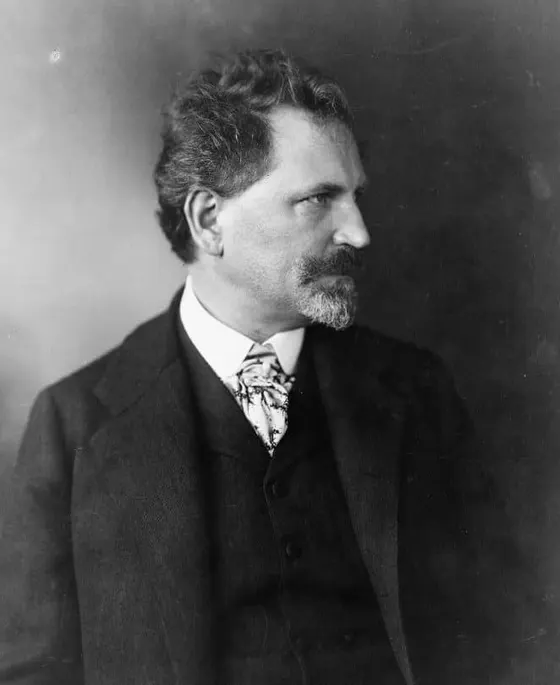
Moravian beginnings
Alfons Maria Mucha was born on July 24, 1860, in Ivančice in Moravia and died on July 14, 1939, in Prague. The familiar story often begins with posters, but the earlier ground of his work matters just as much: music, church culture, drawing, and the experience of image as something that can fill a ceremonial space.
He did not move through formal education in a smooth or privileged way. Financial limits and unstable circumstances shaped the early years. Yet those obstacles did not push him away from art. They seem to have sharpened his instinct for image as a serious vocation rather than a secondary accomplishment.
Theatre, scale, and Vienna
Before Paris, Vienna was crucial. Work on theatre scenery and curtains exposed Mucha to scale, staging, and the relation between figure and architectural frame. This is one of the roots of his later poster language. His images do not simply place a person against a background; they stage presence, build ceremony, and make the surrounding ornament function almost like a proscenium.
Theatricality in Mucha should therefore not be understood as a superficial flourish. It belongs to a deeper habit of thinking about how an image addresses a public, how it slows down the viewer, and how it turns a flat surface into an event.
Moravia, patronage, and the road outward
After returning to Moravia, he gained early support that made further study possible, including the move through Munich and eventually Paris. The biographical importance of this phase lies not only in patronage, but in the fact that Mucha’s work was already operating socially. Recognition, circulation, and visibility were becoming part of the story, not just private development in a studio.
Paris and the public breakthrough
Paris transformed possibility into public form. Illustration, print culture, and commercial commissions placed Mucha in the center of a modern image economy. The breakthrough with Sarah Bernhardt in 1894 mattered not only because it made him famous, but because it clarified what his language could do: elongate the figure, slow the eye, fuse typography with ornament, and turn publicity into an image of prestige.
The Mucha style became immediately recognizable because it solved several problems at once. It sold, announced, beautified, and monumentalized. That combination is why his posters still matter beyond Art Nouveau decoration alone.
Beyond advertising
Reducing Mucha to advertising misses a large part of his achievement. Even within posters, he repeatedly worked on the public image of culture itself: theatre, publishing, exhibitions, music, and later civic or national representation. He was not only designing messages. He was staging legitimacy, beauty, and collective aspiration.
That is why the archive on this site puts commercial posters next to cultural posters, civic commissions, portraits, and late figure studies. The goal is to show continuity as well as change across his career.
Return, The Slav Epic, and later Czech years
After returning to the Czech lands, Mucha did not simply abandon the public image. He widened it. The monumental ambition of The Slav Epic often dominates the later biography, but the late years also include portraits, cultural posters, and works in which Czech identity, ceremony, and memory are condensed into smaller formats.
This later phase is essential because it prevents a narrow reading of Mucha as only the Parisian master of decorative publicity. It shows an artist thinking simultaneously about beauty, history, civic representation, and how a nation might appear to itself.
Why biography matters here
On this site, biography is not treated as background filler. It is a way of reading the works more precisely. Vienna clarifies the theatrical sense of scale. Paris explains the economy of public image. The Czech return sharpens the relation between decoration, identity, and historical ambition. Reading Mucha well means holding those layers together.
Timeline
The expanded timeline frames Mucha's career as a sequence of shifts between scenography, posters, public image, and monumental historical ambition.
- 1860
Ivančice and the Moravian childhood
Mucha is born in Ivančice, already drawn to image-making, music, and visual imagination from an early age.
- 1878
Brno choirs and an early cultural milieu
Music, church singing, and contact with ceremonial settings shape Mucha's sense of rhythm, public presence, and staged atmosphere.
- 1879
Departure for Vienna
Work on theatre scenery introduces him to scale, scenography, and the image as an immersive space.
- 1883
Mikulov and first patronage
After returning from Vienna, he gains crucial support and begins to show how drawing skill can be paired with public visibility and social attention.
- 1885-1887
Munich and academic grounding
Study in Munich gives Mucha technical discipline and broader contact with European academic painting without erasing his instinct for decorative line.
- 1887
Arrival in Paris
Paris opens a field of illustration, book work, and modern print culture. He enters an environment where images operate both culturally and commercially.
- 1894
Paris and the Sarah Bernhardt breakthrough
The Paris commission for Sarah Bernhardt turns him into an artist with a style that is instantly recognizable.
- 1896-1904
The Mucha style as an international public language
Across series, advertisements, and cultural posters, he stabilizes a visual language that joins feminine presence, ornament, print prestige, and modern publicity.
- 1900
Exposition culture and representation
Commissions tied to exhibitions and representational display show that Mucha can work not only for products, but for the public image of institutions, places, and states.
- 1910
Return to the Czech lands
After returning, he shifts emphasis from Parisian commercial fame toward national, historical, and culturally representational ambitions.
- 1910s-1920s
The Slav Epic and later public image
Alongside the monumental historical cycle, he produces later portraits, cultural posters, and civic images that broaden any narrow idea of Mucha as only an Art Nouveau poster designer.
- 1939
Final chapter and legacy
Mucha dies in Prague, but his work continues to matter through the tension it holds between decorative beauty, cultural representation, and modern public image.
Works that structure the biography
These works mark the shift from breakthrough poster design to public representation and later Czech identity.
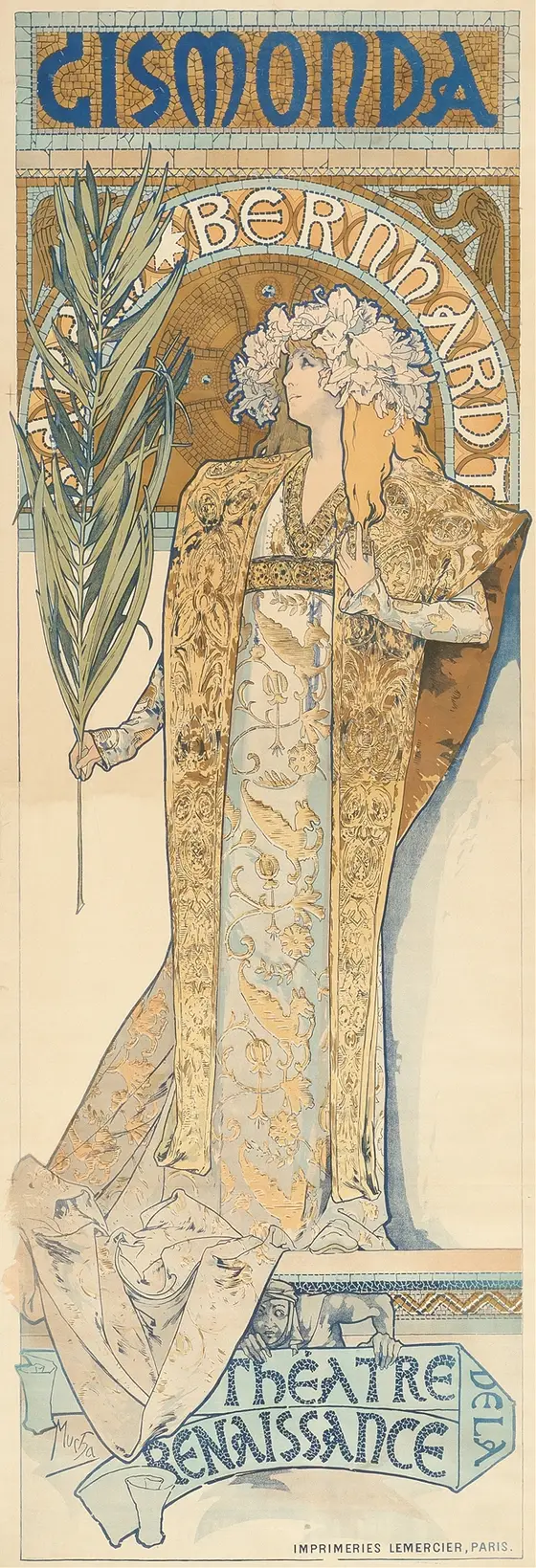
Gismonda
The Bernhardt breakthrough poster that announced Mucha to Paris.
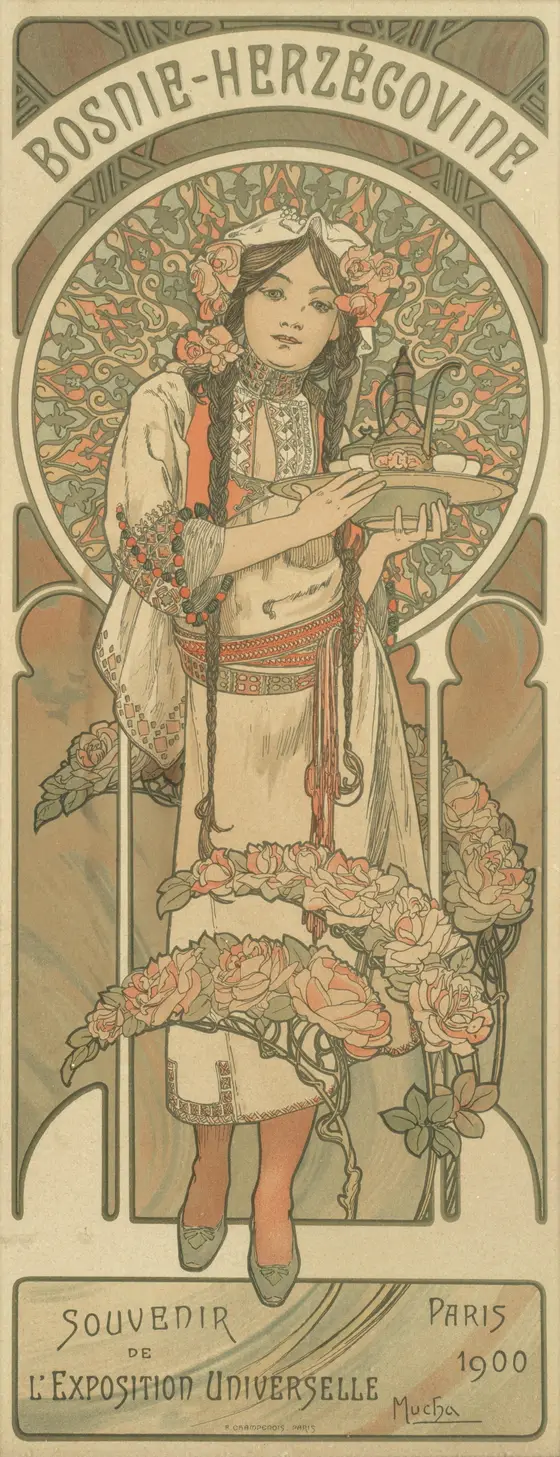
Bosnie-Herzegovine - L’exposition Universelle, Paris
A representational commission sharpened into ceremonial political image-making.
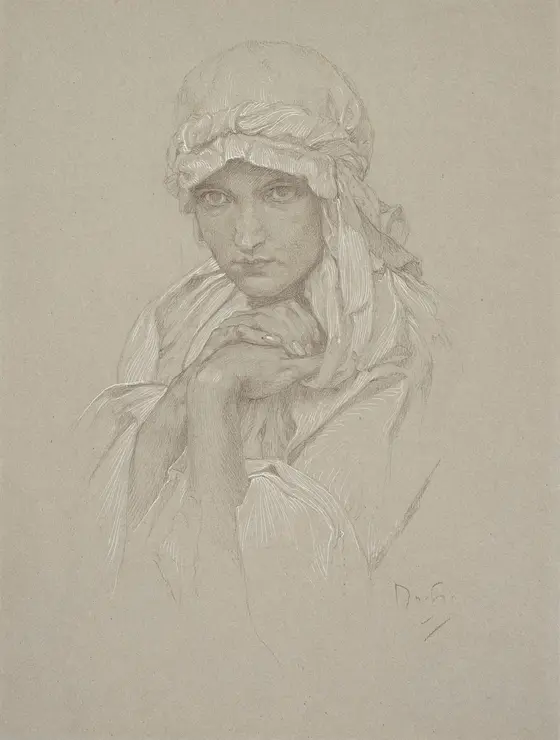
Portrait of the Artist's Daughter in Slavic Dress
A family portrait that joins personal intimacy with Slavic representation and Mucha's later cultural identity.
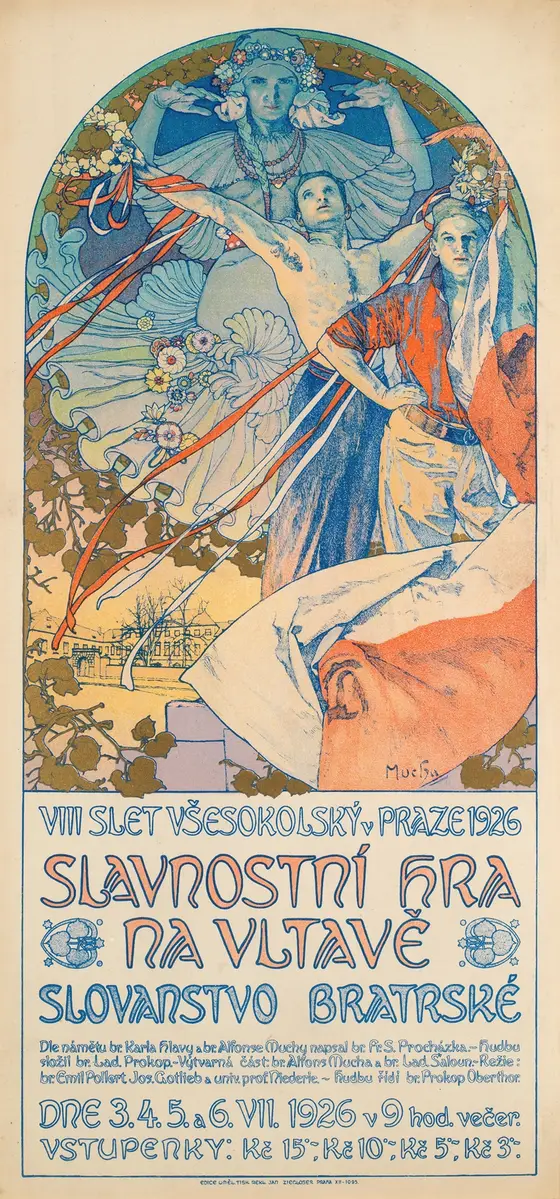
Poster for The Sokol Festival in Prague
A civic festival turned into a confident public emblem of physical culture, citizenship, and ceremonial rhythm.
Essays
The essays connect individual works to larger questions of style, advertising, symbolism, and cultural context.
Civic image from exposition to festival
Mucha's civic works matter because they show him moving from product publicity toward the representation of institutions, nations, and ceremonial public life.
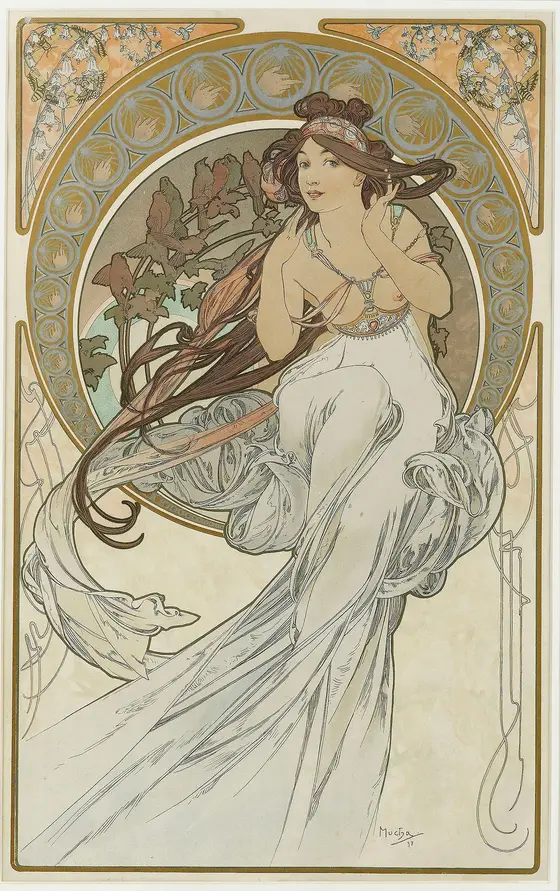
Decorative constellations and paired panels
Mucha's paired decorative panels matter because they show ornament working structurally, not as surface excess. Meaning emerges through echo, counterpart, and visual correspondence.
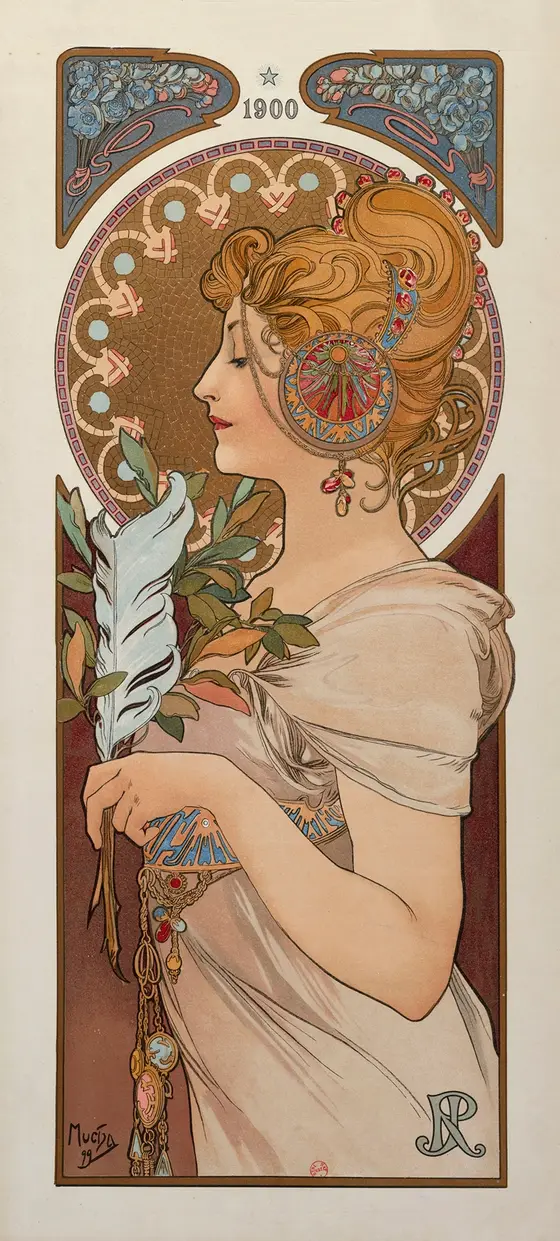
Print culture and recurring visibility
Mucha matters in print culture not only because he designed for magazines and publishers, but because he understood repeated visibility as a form of cultural authority.
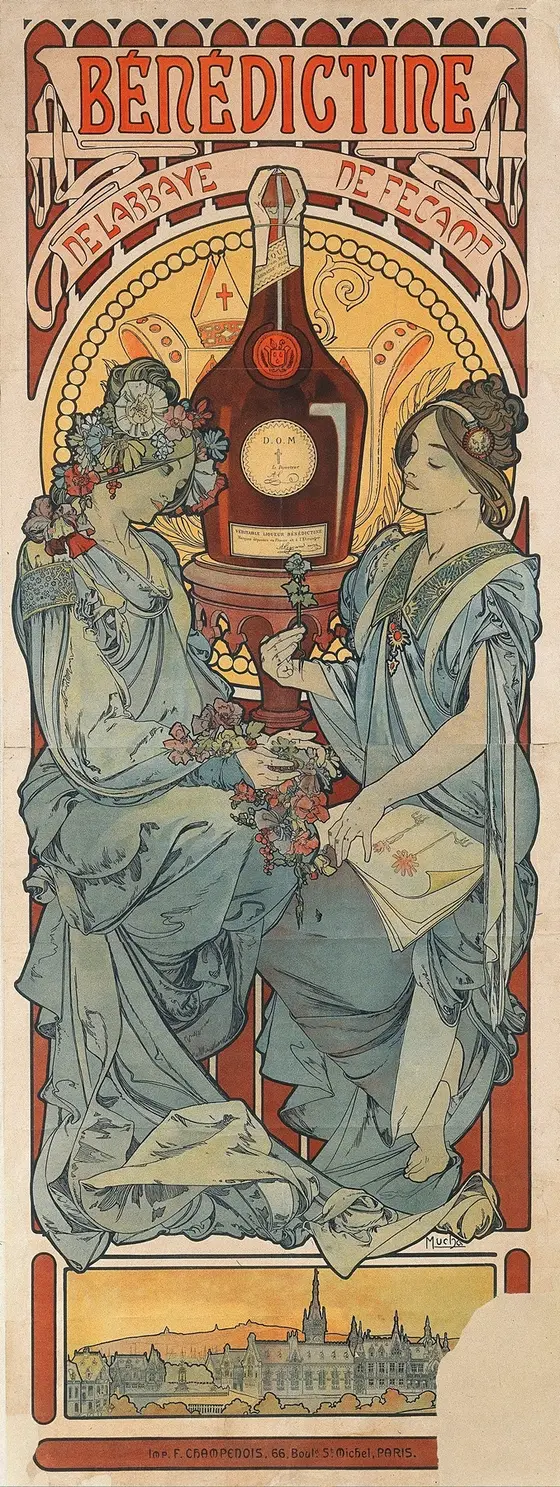
Luxury and public persuasion
Mucha's commercial works matter because they rarely sell through pressure. They persuade by staging luxury, dignity, and the feeling that the product already belongs to a higher cultural register.