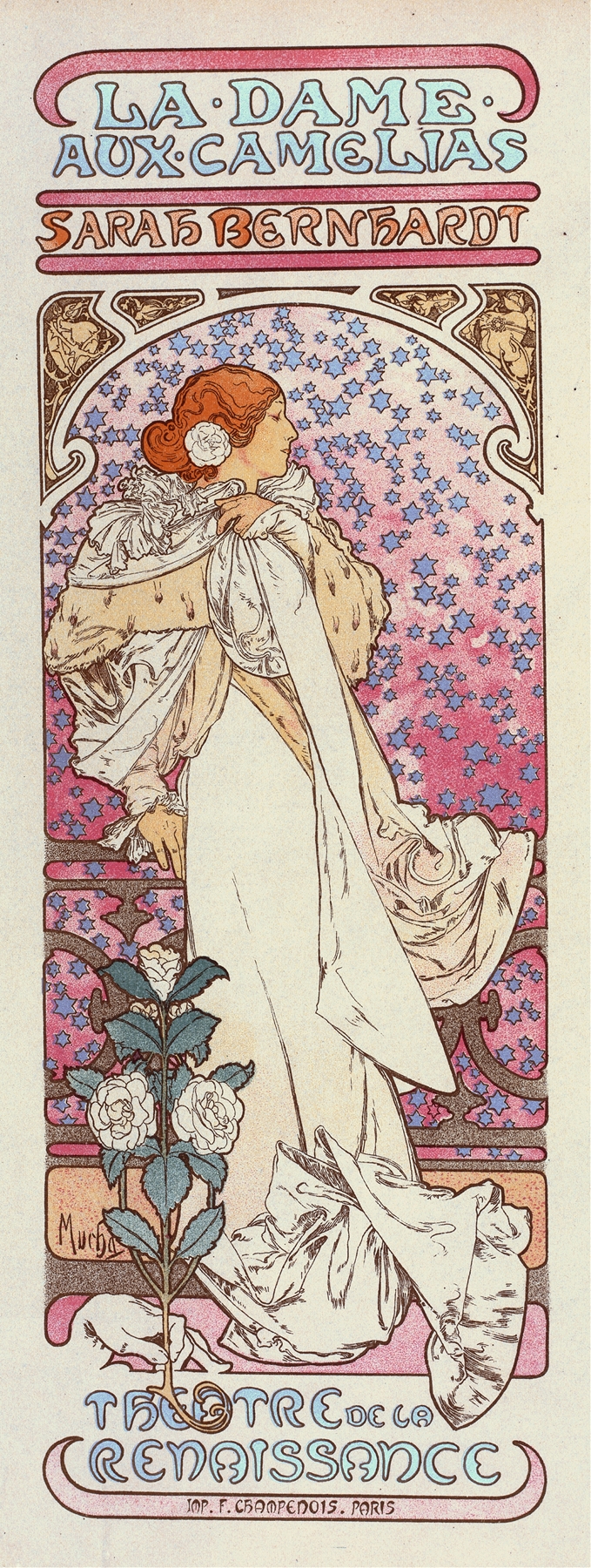
The white camellia
The flower in her red hair is the play's emblem: Dumas's heroine wore white camellias. Mucha pins it on Bernhardt, so the play is present without a single scene.
The camellia spray
A spray of white camellias climbs the left edge; the flower gave the play its title. Mucha draws it as flat, boldly outlined ornamental shapes.
The ermine-trimmed wrap
A long white gown is topped by a wrap with an ermine trim; the rich fur is rendered with only a thin brown line and a pale ochre tone.
The sky of blue stars
The pink ground scattered with blue stars illustrates nothing in the plot. It is a purely decorative field that makes the white figure stand out by colour contrast.
The printer's imprint
The F. Champenois, Paris line at the foot names the printer. Champenois produced most of Mucha's theatre posters of the 1890s.
Short object reading
Object note
This page stays close to the sheet itself: composition, historical setting, and the work's place in the archive.
The poster advertises Sarah Bernhardt in La Dame aux Camélias, the play based on Alexandre Dumas fils, at the Théâtre de la Renaissance in Paris. The printer’s imprint of F. Champenois appears at the foot of the sheet, and the museum record at the V&A dates the poster to 1896.
Mucha leaves out any scene from the drama. A single figure in a long white gown and ermine-trimmed wrap stands in profile, a white flower in her red hair, while a spray of white camellias climbs the left edge. The flower gives the play its title and its emblem, and the pale tones of the figure are set against a pink ground scattered with blue stars.
In deep zoom, look at the lettering: the title and the name of Bernhardt are drawn in Mucha’s own rounded capitals rather than a standard typeface. Follow the thin brown contour line that draws the folds of the drapery, and compare it with the grainy lithographic colour in the sky and the border panels.
Go deeper
Related essays
These essays step back from the sheet and open the broader argument around medium, public role, and curatorial context.
Related works
 5 explained symbols
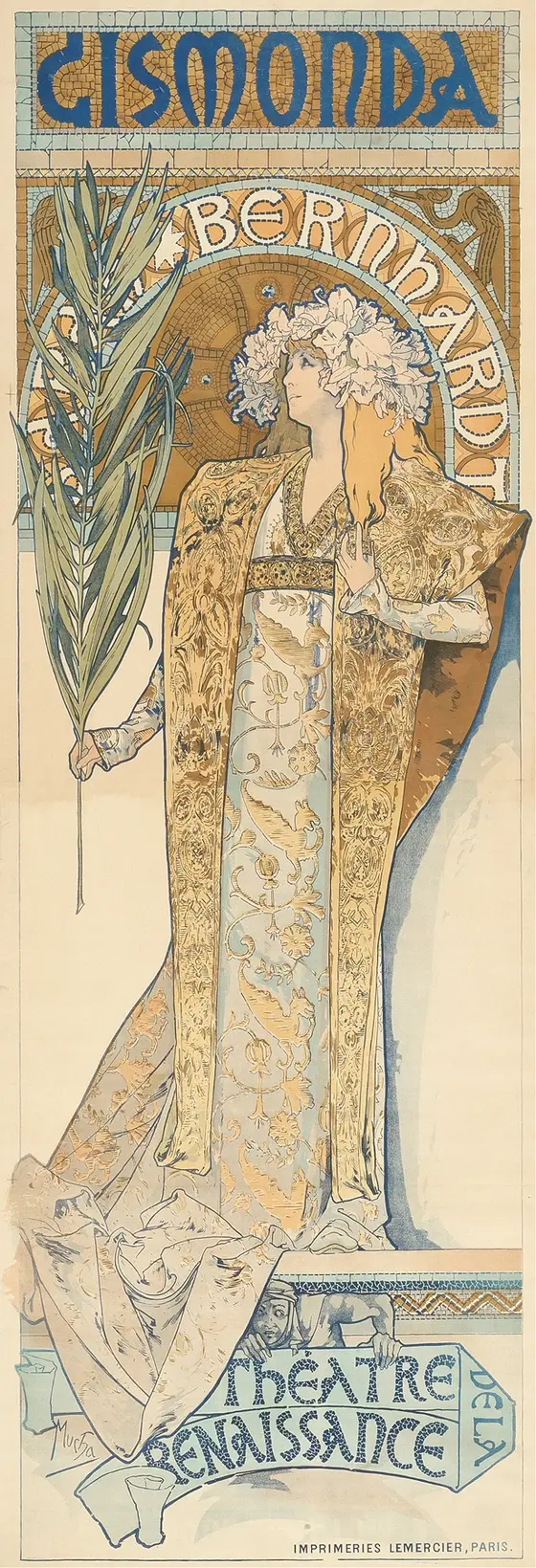
Gismonda
The Bernhardt breakthrough poster that announced Mucha to Paris.
 5 explained symbols
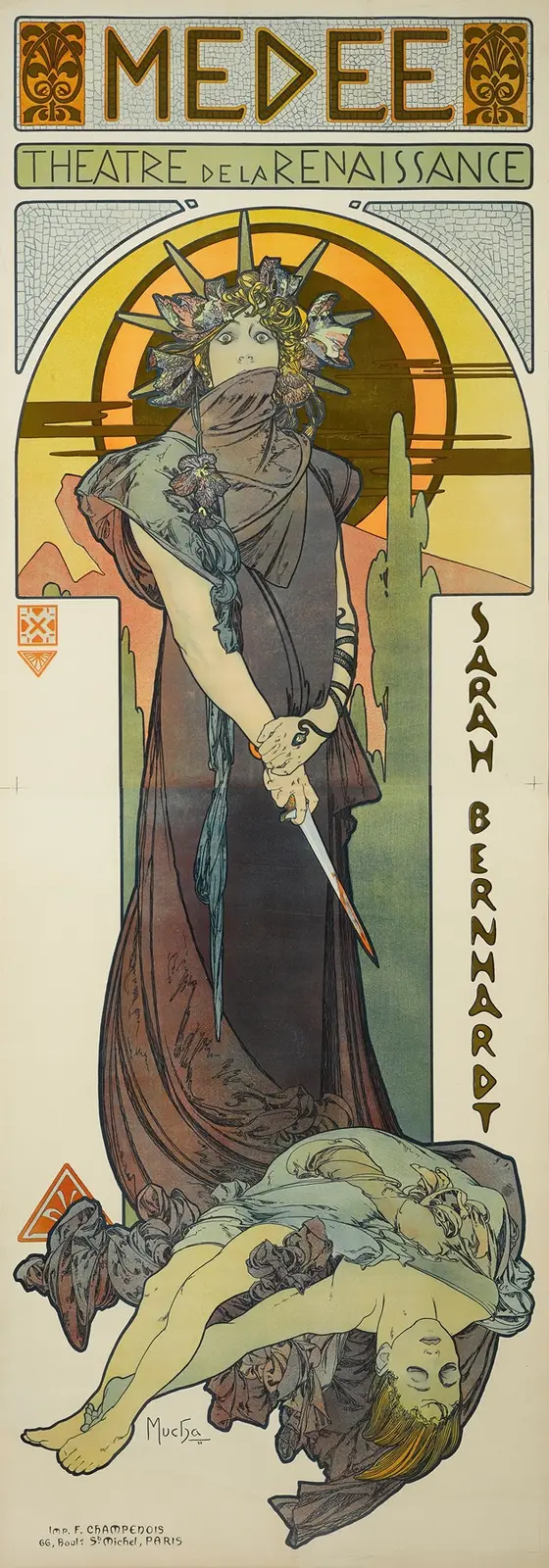
Medee
A darker Mucha built from ritual tension rather than sweetness.
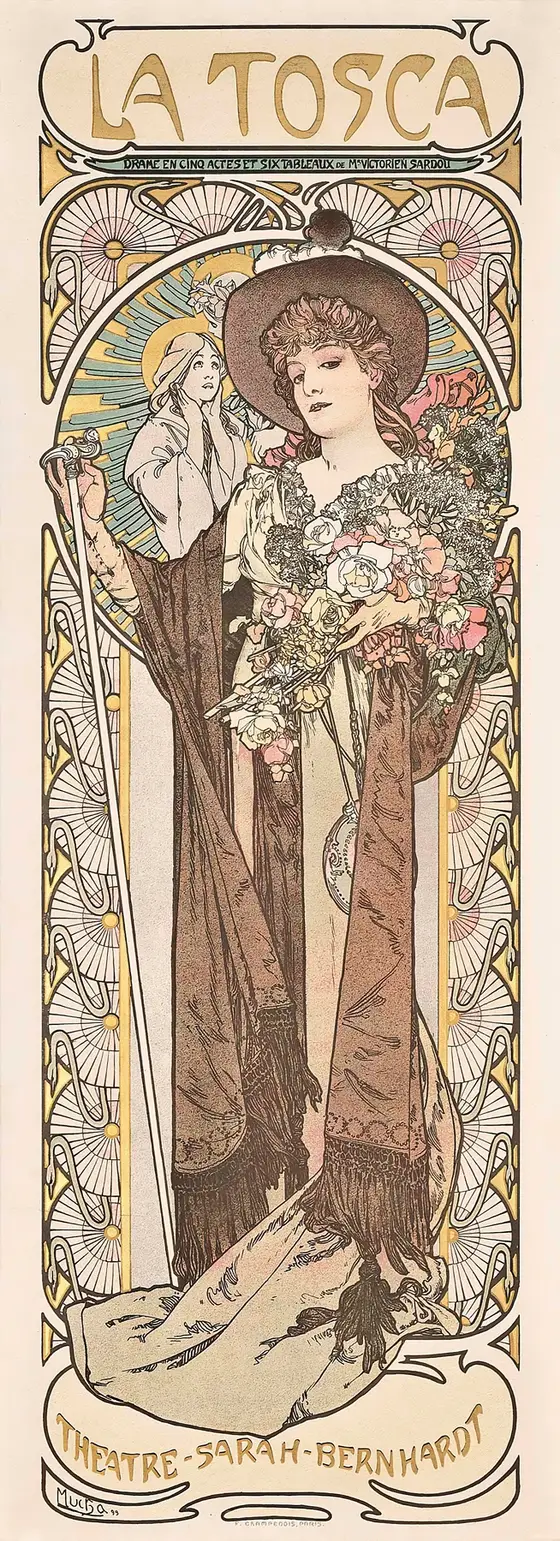
LA TOSCA
Operatic drama compressed into a tall image of ritual tension.
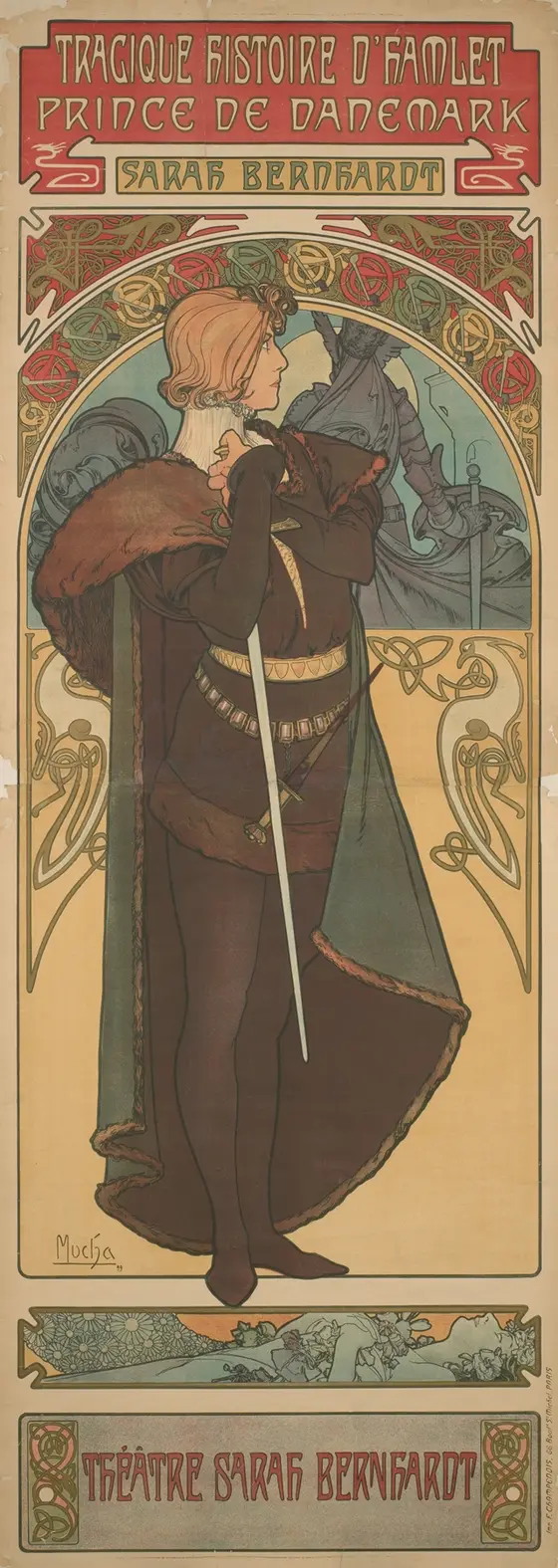
Sarah Bernhardt as Hamlet
Bernhardt as Hamlet, where theatrical identity becomes a monumental emblem of role and presence.