Mosaic lettering
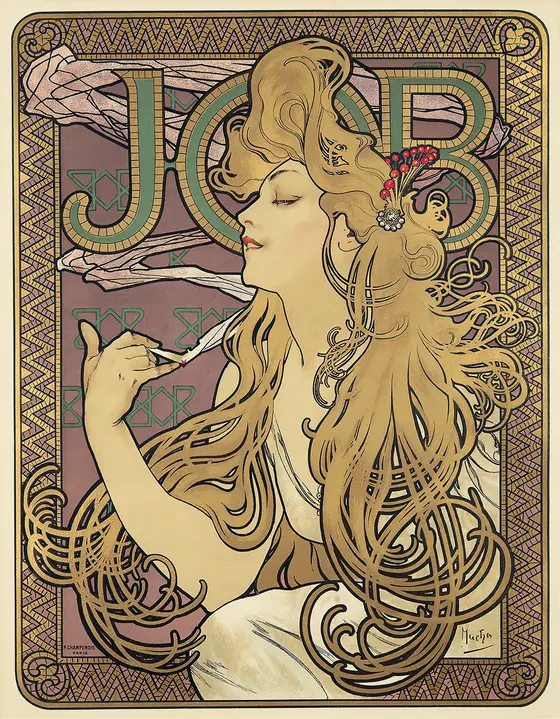
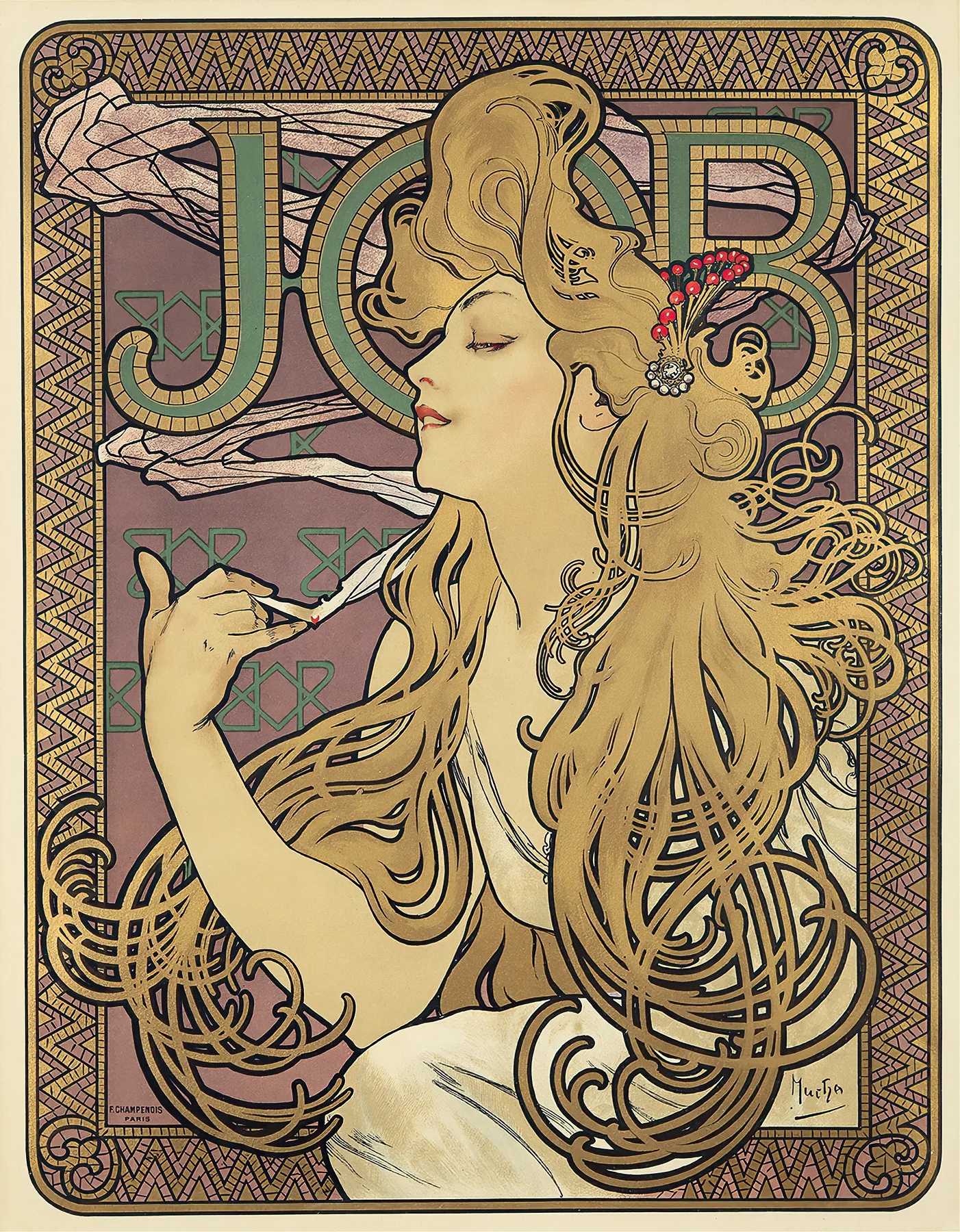
The JOB letters are built from brick-like tiles in gold and green, so the brand name becomes part of the ornament rather than a caption.
Smoke as ornament
Smoke winds between the letters like another decorative band. Its soft line contrasts with the firm geometry of the lettering.
The glowing cigarette
She holds a rolled cigarette with a glowing tip between two fingers. The poster advertised JOB cigarette papers, so this small detail carries the whole message.
Jewelled hair ornament
A hair ornament with red beads and a pearl-set centre glows in her hair, the most saturated colour accent in an otherwise gold-and-brown design.
Hair as arabesque
Her long hair unfolds into golden loops that fill the lower half of the poster. The hair works as an ornament in its own right.
Short object reading
Object note
This page stays close to the sheet itself: composition, historical setting, and the work's place in the archive.
Why the poster works
Job is one of the clearest examples of Mucha’s ability to turn a commercial commission into a total visual environment. The woman’s profile, the extravagant halo of hair, and the carefully staged lettering do not compete with each other. They create a single brand image that feels luxurious and immediately legible.
Historical context
By 1896, Mucha had already become a recognisable name in Paris. Posters like this helped define the public face of Art Nouveau, where commerce and ornament were not opposites but active partners. The image sells cigarette papers, yet it also operates as a manifesto for a new decorative language.
Why it belongs in this gallery
For the project, Job is essential because it shows how Mucha translated atmosphere into persuasion. It expands the gallery beyond theatrical commissions and makes the commercial power of his poster design impossible to miss.
Go deeper
Related essays
These essays step back from the sheet and open the broader argument around medium, public role, and curatorial context.