Post-Impressionism · Paris, France
Henri de Toulouse-Lautrec
1864–1901
French painter and printmaker, chronicler of Paris's Montmartre and the Moulin Rouge, whose colour lithograph posters anticipated Art Nouveau.
Who he was
Origins and training
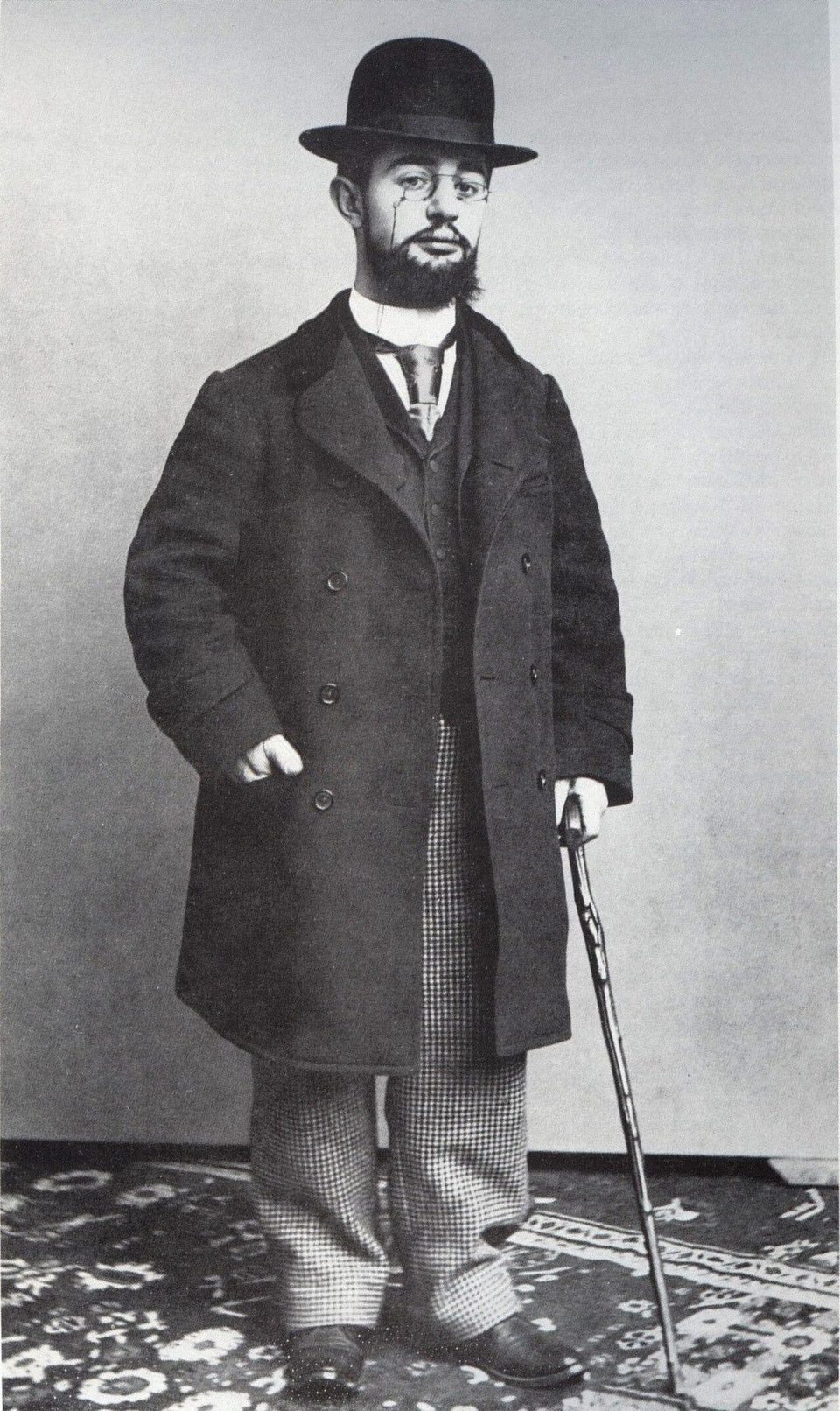
Henri-Marie-Raymond de Toulouse-Lautrec Monfa was born on 24 November 1864 in the family palace Le Bosc in Albi, into the old aristocratic house of the counts of Toulouse, which traced its descent to Charlemagne. His parents were first cousins, and from an early age he suffered from a rare bone disorder. After breaking his thigh bones in 1878 and 1879, his already slow growth virtually stopped, and as an adult he was 130 cm tall. During his convalescence he returned intensively to drawing and painting; his uncle Charles gave him his first lessons.
After finishing school in 1881 he became a pupil of the deaf-mute painter of racing scenes René Princeteau, then studied with Léon Bonnat and, from 1883, with Fernand Cormon. Both studios were in Montmartre, where Lautrec met young painters including Louis Anquetin, Émile Bernard and, in 1886, Vincent van Gogh. In 1884 he took his own studio there.
Breakthrough and mature work
Montmartre and its cabarets, such as Le Chat Noir and Aristide Bruant’s Le Mirliton, became his world. In 1888 he exhibited with Les XX in Brussels and from 1889 regularly at the Salon des Indépendants; Theo van Gogh bought several of his paintings. The decisive turn was the poster for the Moulin Rouge for the 1891 season, which made him famous almost overnight. He often painted the dancers La Goulue and Jane Avril there, and had his own table in the cabaret.
From 1892 he worked, and in effect lived, in brothels, and in 1896 he published the album of eleven lithographs Elles. The same year he had his first and only solo show in Paris, followed in May 1898 by a solo exhibition at the Goupil gallery in London. Alcohol and syphilis, however, gradually undermined his health; in February 1899 he was taken to a clinic, which he left after three months. He died on 9 September 1901 at Malromé, aged 36.
Style and what to look for
Lautrec built on Impressionism and Post-Impressionism, above all Edgar Degas, and was strongly influenced by Japanese woodblock prints. His expression grew from drawing: he used coloured line, thin oil paint and often let the grey cardboard show through. The paintings feel spontaneous, yet he mostly painted them in the studio from models, working from preparatory drawings and photographs.
In his lithographed posters he reduced everything inessential and cut figures with unusual compositions. Look at how the Caudieux poster slices the figure radically, and how flat areas of colour recall Japanese prints. His subjects come from Montmartre: cabarets, dancers, singers and people from the margins of society. He did not glorify the brothels but paid attention to the inner pain of the women he painted.
Legacy
Lautrec’s output is vast: 737 oil paintings, 275 watercolours, 5,084 drawings and 359 lithographs, among them 31 posters. His posters and prints influenced Art Nouveau and the Nabis, acted on Pierre Bonnard and Edvard Munch, and Pablo Picasso admired him, especially in the Blue and Rose periods. Among Czech artists, Luděk Marold, Miloš Jiránek, František Kupka and František Kobliha were influenced by him to some degree. In 1922 the Toulouse-Lautrec Museum opened in Albi, holding a substantial part of his work.
Did you know?
- He collected Japanese woodblock prints and planned a trip to Japan.
- In 1896 he helped paint the sets for Jarry’s play Ubu Roi.
- In the clinic he drew a circus cycle from memory to convince the doctors that he was well.
- Asked by Misia Natanson why he always made women so ugly, he replied: “Because they are!”
Sources

Timeline
- 1864
Born in Albi
Henri was born on 24 November 1864 in the family palace Le Bosc in Albi, into an old aristocratic house.
- 1878–1879
Two fractures
After breaking his left and, a year later, his right thigh bone, his growth virtually stopped; as an adult he was 130 cm tall.
- 1882–1883
With Bonnat and Cormon
He studied in the studios of the academic painters Léon Bonnat and Fernand Cormon in Montmartre.
- 1884
First Montmartre studio
He took his own studio and began to live in the cabaret district that became the main subject of his work.
- 1891
Moulin Rouge poster
The poster for the 1891 season made him famous almost overnight.
- 1896
Solo show and Elles
He had his first and only solo exhibition in Paris and made the album of eleven lithographs Elles.
- 1899
Stay in a clinic
He left a clinic for the mentally ill after three months, helped by a cycle of circus drawings made from memory.
- 1901
Death at Malromé
He died on 9 September 1901, aged 36, at his mother's château of Malromé.
- 1922
Museum in Albi
The Toulouse-Lautrec Museum opened in the former episcopal palace La Berbie.
Henri de Toulouse-Lautrec became famous for these works:
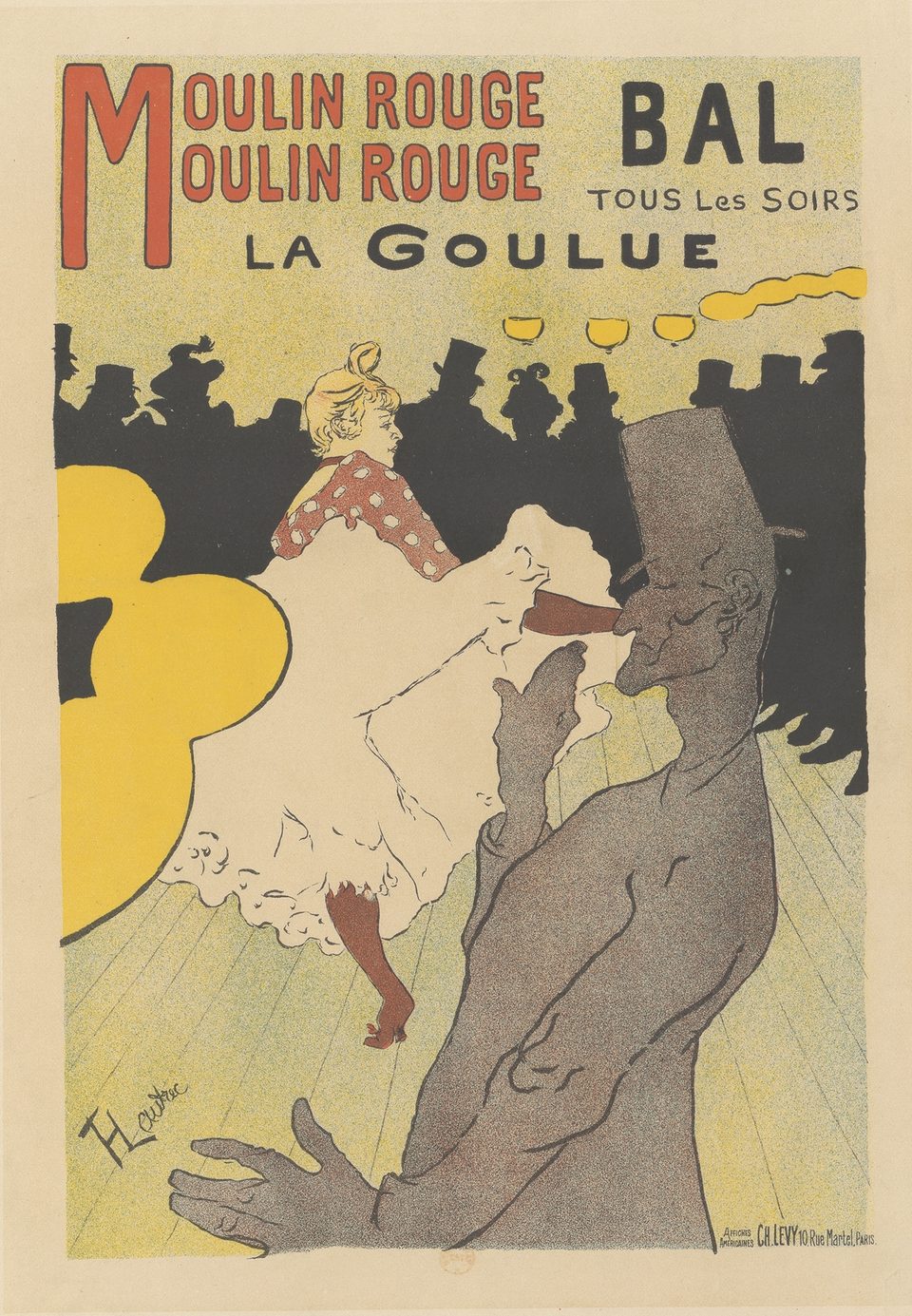
Moulin Rouge: La Goulue
Lautrec's first commission for graphic work: the poster for the 1891 season made him famous almost overnight.
Source ↗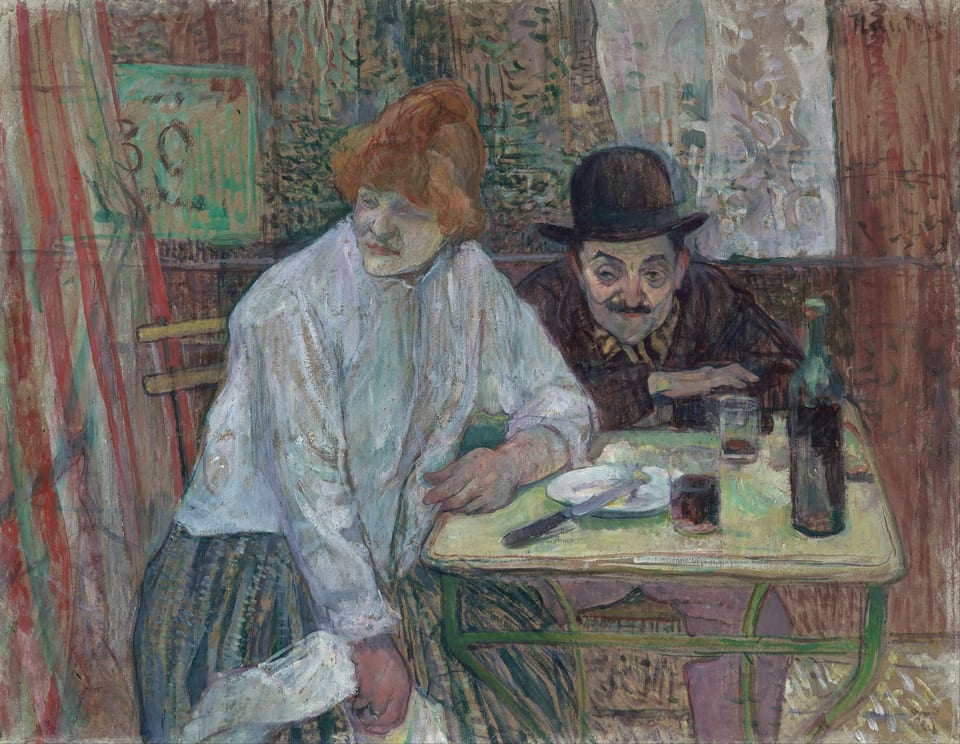
At the Café La Mie
It shows a drinking couple; a preparatory photograph survives in which a hired model and the painter's friend Maurice Guibert pose for it.
Source ↗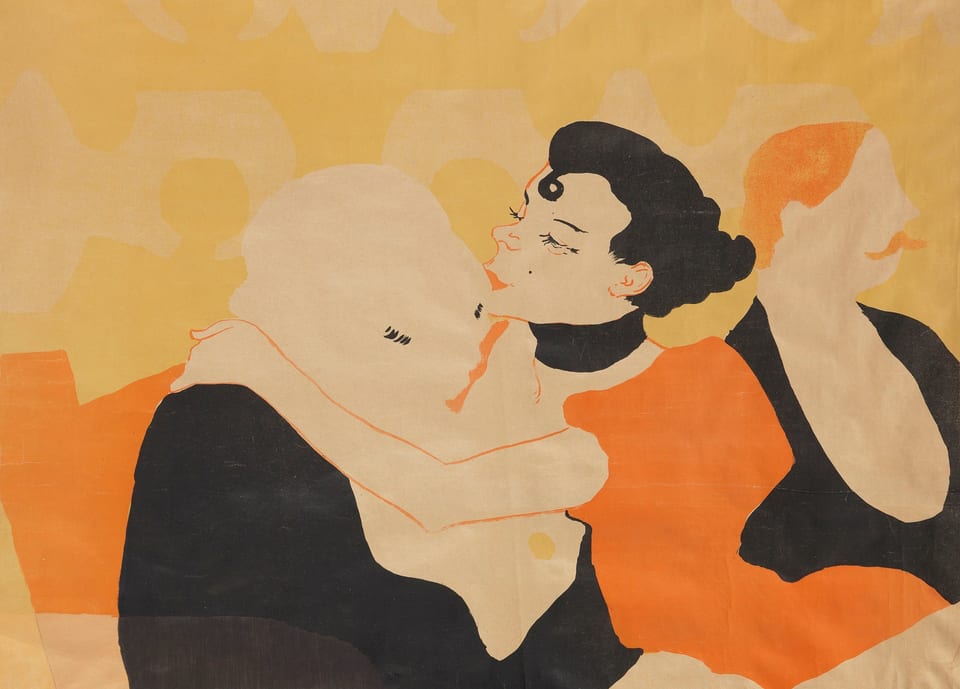
Reine de Joie
One of the early posters in which Lautrec consistently reduced everything inessential to the core of the image.
Source ↗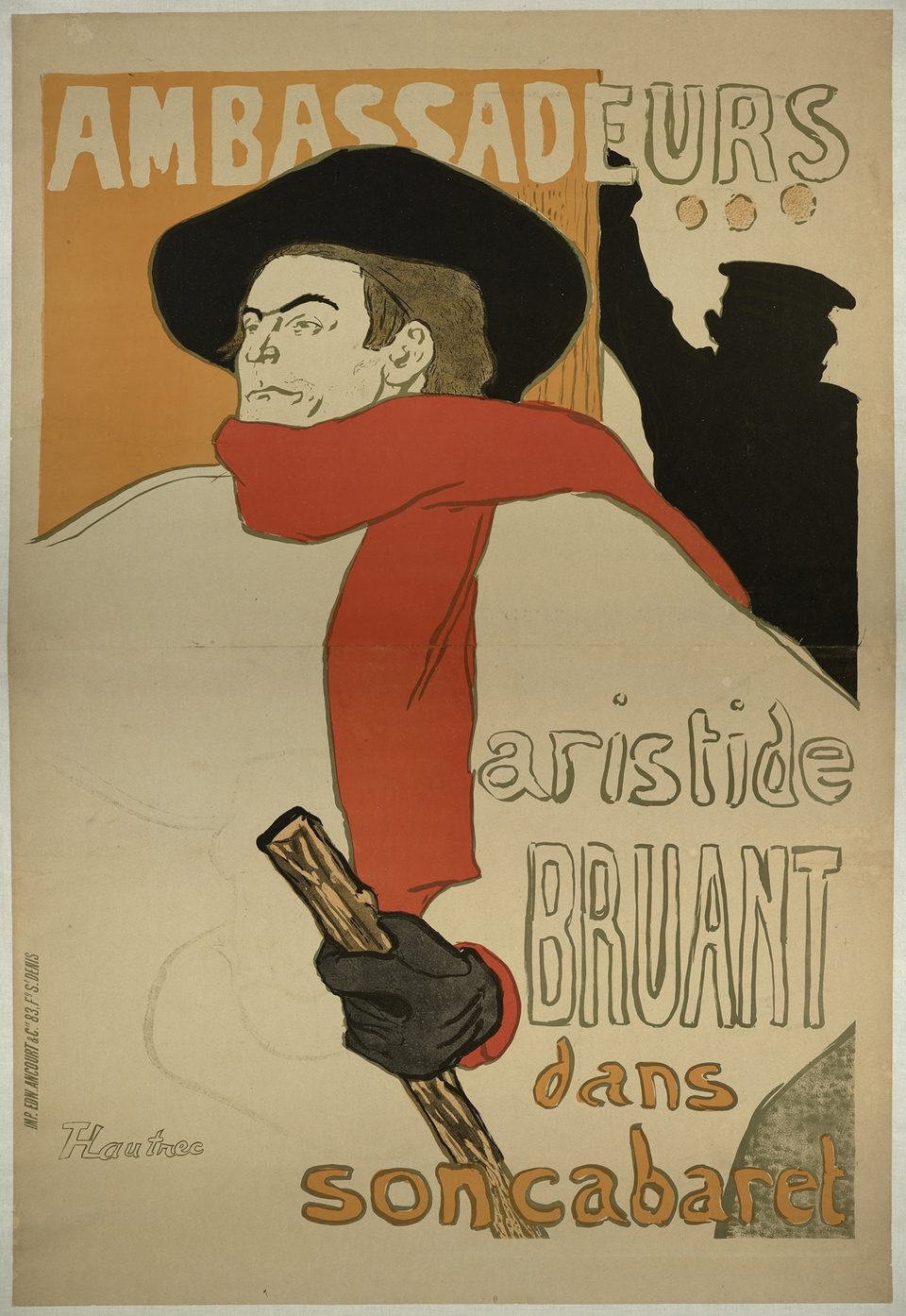
Ambassadeurs: Aristide Bruant
A portrait of the cabaret owner Aristide Bruant, whose cabaret Le Mirliton was the first place where Lautrec's paintings could be seen.
Source ↗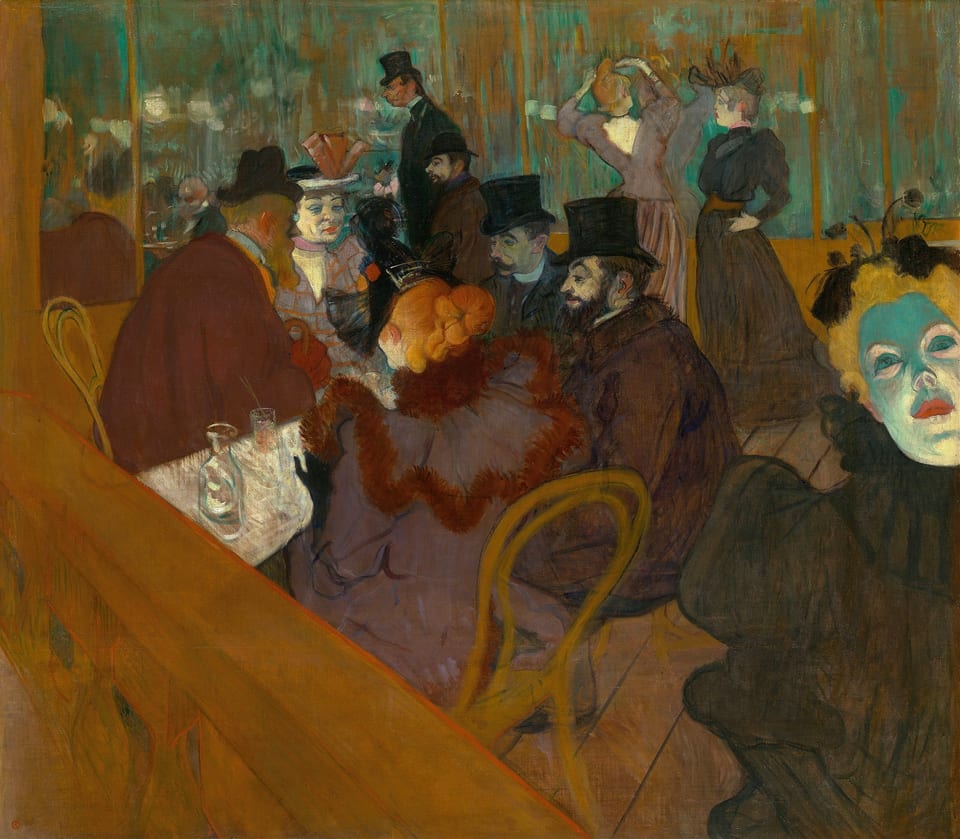
At the Moulin Rouge
This large canvas shows a company of Lautrec's friends at a table, the painter himself among them; it was later enlarged and extended.
Source ↗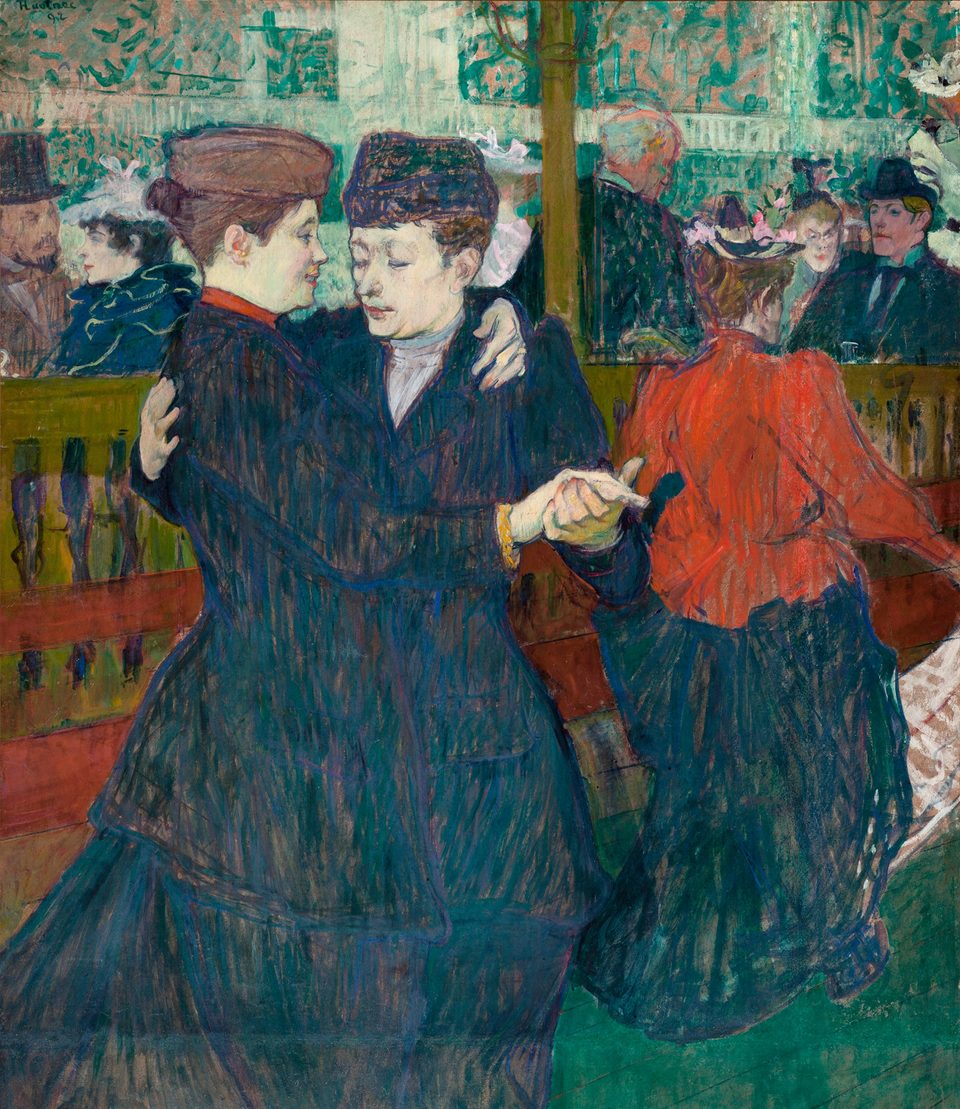
Moulin Rouge: Two Women Waltzing
The painting in the National Gallery in Prague is a precise description of the Moulin Rouge; Lautrec later added a strip at the right, giving it a more dynamic composition.
Source ↗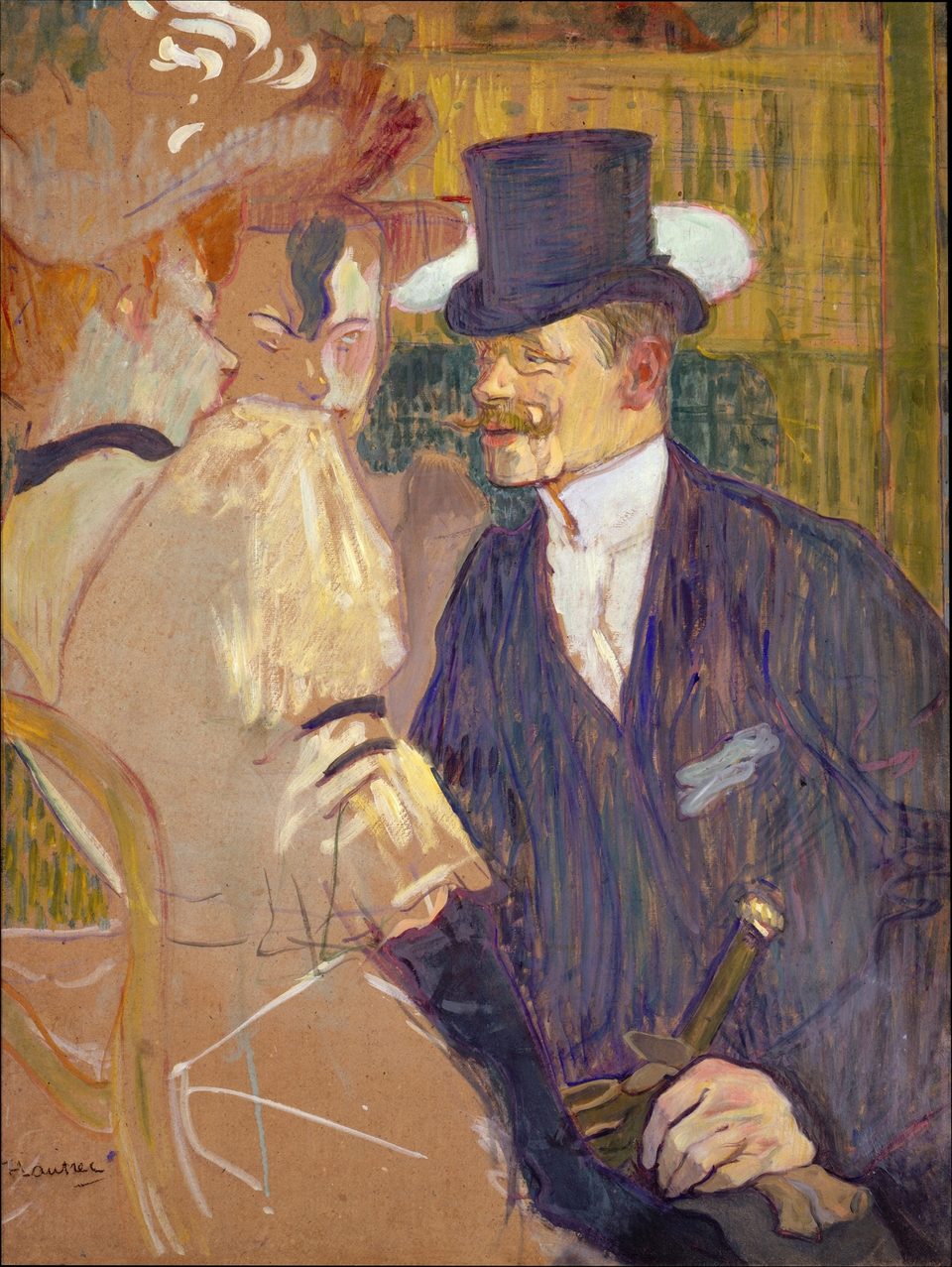
The Englishman at the Moulin Rouge
Lautrec treated this subject both as an oil on cardboard and as a lithograph.
Source ↗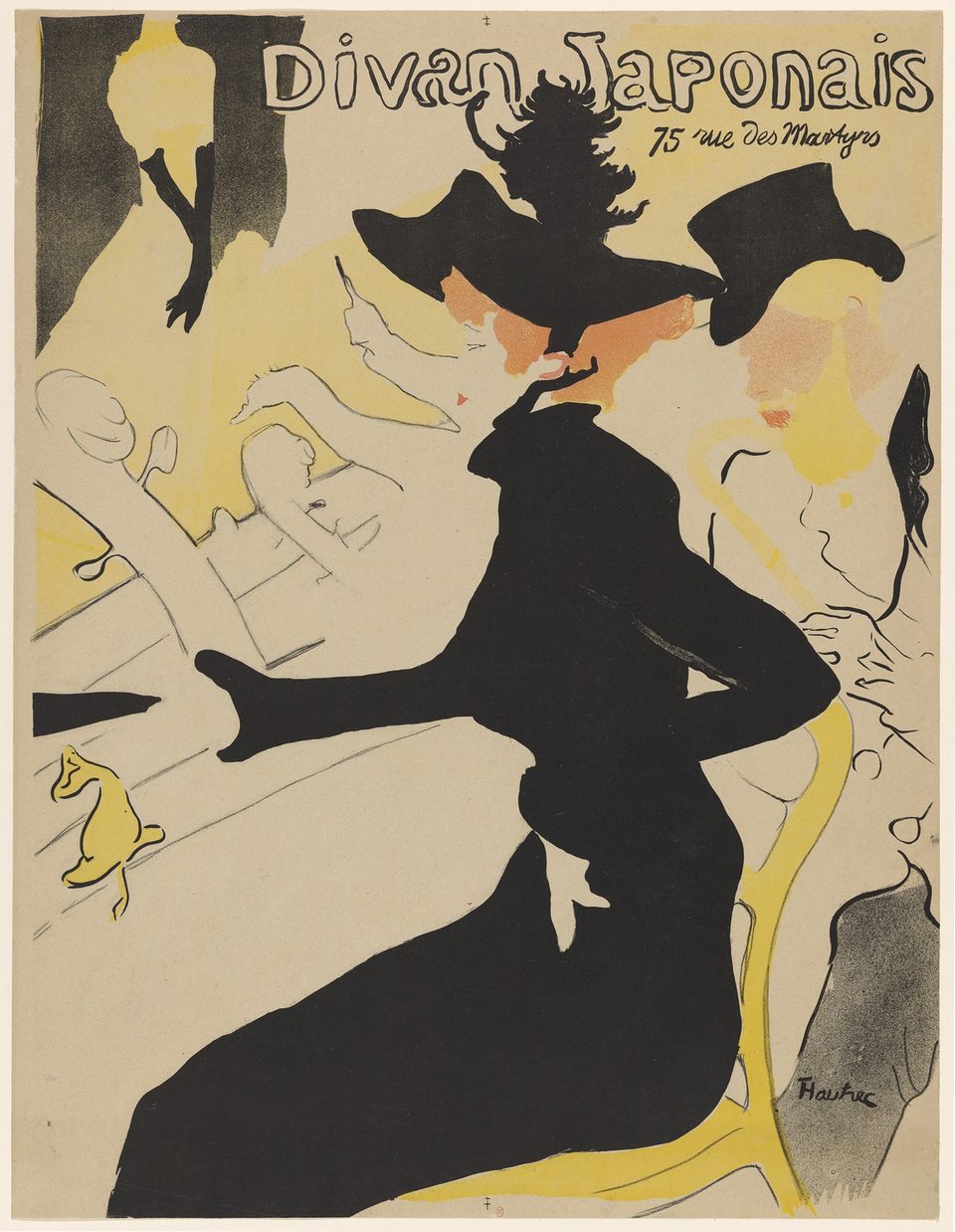
Divan Japonais
Posters like this reflect the inspiration of colour Japanese woodblock prints, which Lautrec collected.
Source ↗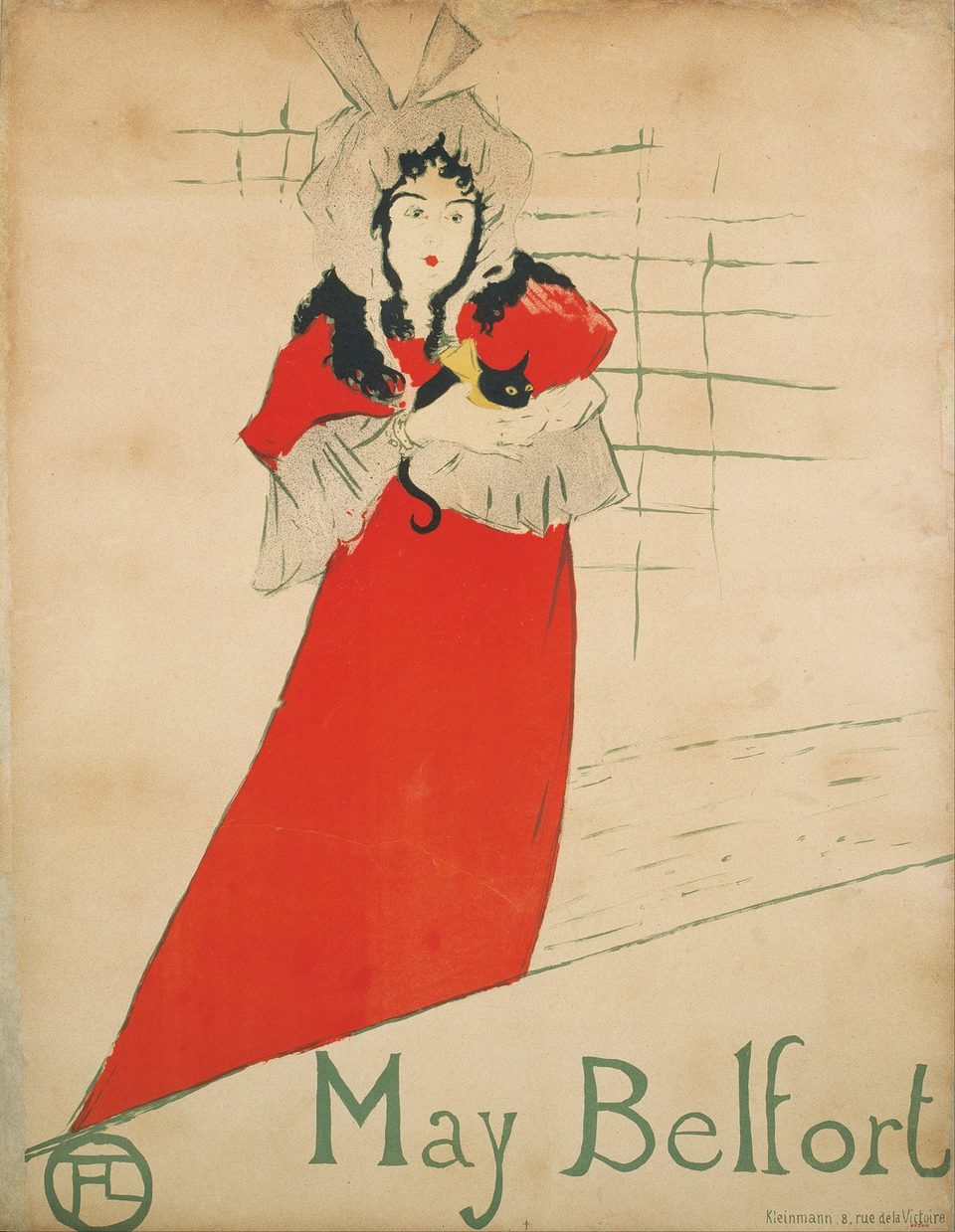
May Belfort
In 1895 Lautrec shocked Paris with the simplicity and force of a pair of posters of May Belfort and May Milton.
Source ↗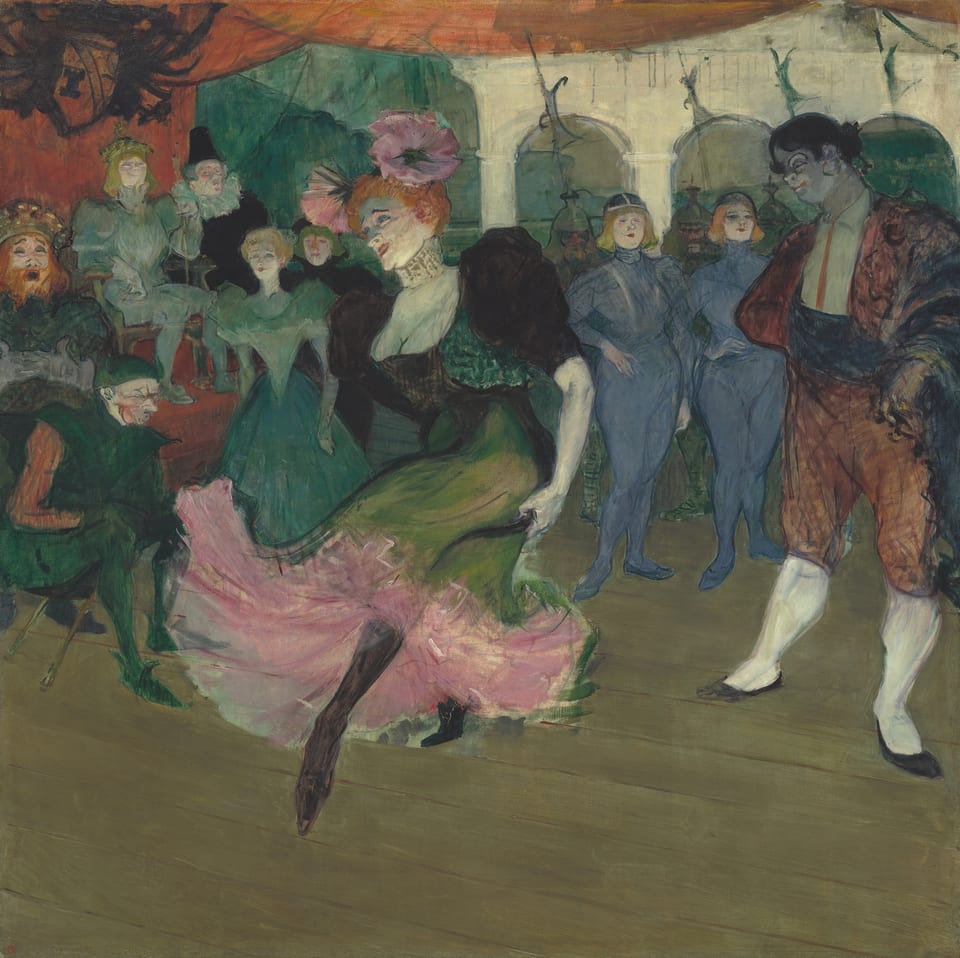
Marcelle Lender Dancing the Bolero in Chilpéric
The painting, inspired by a theatre performance, stands out for its saturated colours, its sense of movement and its composition.
Source ↗Sources and rights
Artvee (works), Wikimedia Commons (portrait)
The painter died in 1901, so his works have been in the public domain in the EU since 1972. Paul Sescau's 1894 portrait photograph is in the public domain.
https://artvee.com/artist/henri-de-toulouse-lautrec/
All artists